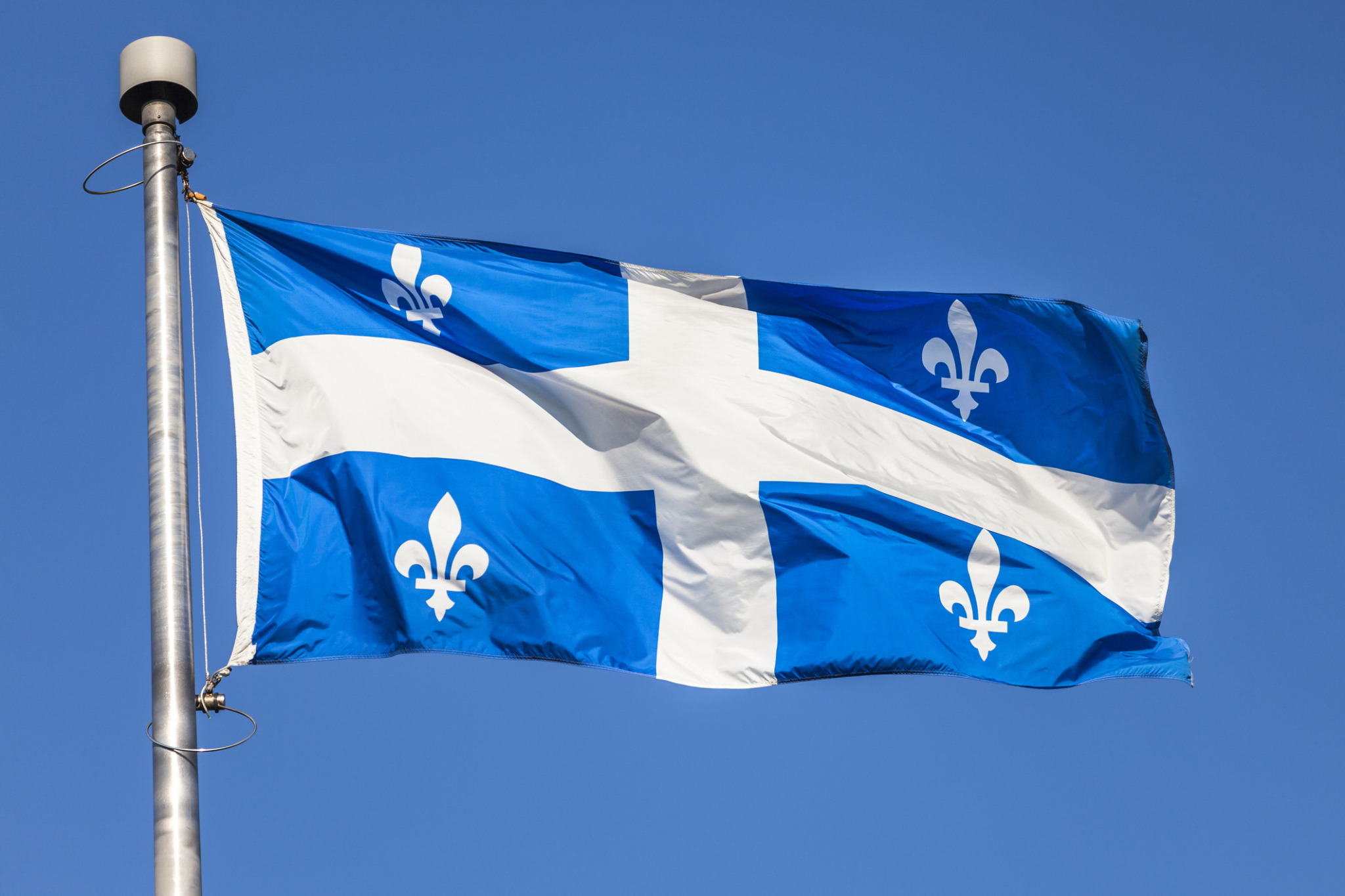
You probably heard of this before, the Canadian province of Quebec has been aiming and pushing for Independence since as long as nearly (Rest in Hell Elizabeth) all of us has been alive. I'd like to talk about the events and pros/cons. Prefaced, I am undoubtably pro-independence, so my arguments against should be challenged.
If you know about the American Revolution, you know that the Americans offered Quebec to join the rebellion from the British, this offer was denied by the French due to the protections the English gave to the French not being matched by the Americans.
However, these protections did not come with things like Responsible Government or any local rights, this later led to the Canadian colonies having their own rebellions as they faught for their own rights much like the Americans did before them.
An important distinction between French and English societies in North America is that the French did not see any possible ventures for capital to be exploited, leaving no investments into the colonies after the fur trade died down, and French people within France's society would rather remain in France as they had a rather functional society and one that worked well for its people. In comparison, the English were always seeking new places to send colonists both free and imprisoned, as they followed the Whig doctrine of overpopulation and they did indeed have a massive population of people living in absolute poverty begging for places to move to (and overcrowding private prisons).
The result of this is the Canadiens grew from natural birthrates and did not have the backing of any army when dealing with the Natives, forcing them to integrate into the Native's system, fight their own wars (and therefore try to avoid bloodshed of their own), creating alliances and enemies in the New World to work with and against. The English instead forced themselves as the single greatest force in the region, with the full backing of Her Majesty's professional Army, with endless immigration from the Old World and the Slave Trade.
This all came down to Lord Durham's report, which encouraged the merging of the Canadas and the giving of Responsible Government. The merging was a necessary act, as Durham believed the French and Natives (which he classed together) were backwater savages and needed to be made a minority in the country before any sort of local autonomy could be given, to ensure the English held a majority and could 'educate' the rest. This is the precursor to the Residential School system.
The Roman Catholic Church, having recently lost France to the French Revolution, now had a close interest in Quebec as one of the few French speaking Catholic areas left. This came at a perfect time as the French were being subjucated by the English and was in need of protection, letting the Catholic Church give itself the responsibility of ensuring the French language and culture in Quebec remained by integrating themselves and their religion as a mandatory part of that culture.
This put the Catholic Church as a dominant force in Quebec geopolitics, in control of the Education system, healthcare system, and much of every-day life for all French citizens in Quebec. This period is sometimes referred to as the Grande Noirceur (Great Darkness), as Quebec was kept rural and non-industrialized by the Catholic Church in attempts to keep them from moving away from Catholicism.
This resulted in the complete sidelining of Quebec in the world and within Canada, despite being the second largest province by population and one of the founding provinces.
The Church was often at odds with English Canada, not only following a different religion but also a different lifestyle that came along with it a less symbiotic relationship with religion as a whole; This put Anglos as a common enemy and threat to the Church, and therefore the Canadien.
With the differences in education levels and the stronghold the Catholic church held over the nation, Quebec had fallen behind in a slowly industrializing and urbanizing Canada; one which Quebec refused to participate in, and the areas that did industrialize like Montreal, were English.
The English also had wealth inherited from their family, financial backing from other projects throughout Canada, and the advantage of sharing a common language for commerce in the British Market as a whole, giving them massive advantages over Quebeckers even down to local job markets in the cities.
This lead to English being the dominant language in commerce in Quebec, which even further disenfranchised the French as they were unable to speak the same language as their bosses. As a footnote, we see this sourspot to this day with Bill 96 which seeks to enforce French as the language of commerce.
This put the English as the bourgeoisie and the French as the proletariat within Quebec society, demonstrated rather well in this classic NFB story by Sheldon Cohen, where the Church takes a simple English shirt as a threat to the group, and school teachers don't understand English nor how letters to businesses aren't read by the CEOs themselves.
This wealth disparity is visible to this day in the differences of English West Montreal, where there's more Liberal voters and the Metro has heavy presence, and French Eastern Montreal, which is more rural, pro-Independence voters with very lackluster public transportation options.
Leading up to the modern Quebec Independence movement were the Automatistes, a group of art students in Montreal that are today seen as forerunners of Canadian avant-garde in the arts.
In 1948, this group published the Refus Global (Total Refusal), that was anti-capitalist, decolonialist, anti-establishment and anti-religious in nature, this lead to mass criticisms by the Catholic population, the English Capitalist Establishment, and the Catholic-dominated local Governments.
In 1949, a strike in Asbestos, Quebec (can you guess what for?) occured in which the at-the-time Premier, Maurice Duplessis, attempted to crush union activities at any costs as he was a hardline anti-socialist pro-establishment catholic conservative.
The refus and strike became some of the largest inspirations for the start of the Quiet Revolution, which was the rapid construction of Quebec as a state through secularization, nationalization, and revival of the political and sociological life in Quebec as a secular welfare state.
This rapid transformation was spearheaded by the Quebec Liberals (severed from the Federal party) under Jean Lesage, but finished with one of the most important peoples in Quebec history; René Lévesque, who nationalized Hydro-Québec under the "Maîtres Chez Nous" propaganda piece ("Masters of ourselves"), which aimed to have the province of Quebec take control over its own resources and use one of the richest areas of potential hydro electricity to power the whole province.
This move was what René wanted to use as proof Quebec was fully able to take care of themselves as a secular society and therefore, able exist as an independent state.
This later got pushed to the extreme during Expo 67, which was held in Montreal. This world exposition pushed the city and the province
to max speed, which brought to the city a brand new Montreal Metro (with the brand new Yellow line) and Notre Dame Island (yes, the island as a whole was artificially built), which was both used in Expo 67 and later gifted to the City of Montreal.
The remains of Expo 67 is now the most widely used Metro service in Canada, the LaRonde amusement park, the Casino of Montreal (French Pavillion), the Montreal Biosphere (American Pavillion), among many other notable attractions.
Most importantly, Expo 67 is where Charles De Gaulle's famous speech in Montreal happened, in which he called for a "Quebec Libre" ("Free Quebec").
Since then, Quebec felt it was held back by an Imperialist English Canadian project, and was better off as its own independent country.
The Front de libération du Québec (Quebec Liberation Front) was a Communist Revolutionary group that called for Quebec's independence and creation as a Communist 'Workers State', away from Anglo imperialism.
In 1970, with the kidnapping of a British Trade Commissioner and an individual named Pierre Laporte, who was the Minister of Immigration, Manpower and of Labour, and the Deputy-Premier (or Vice-Premier) of Quebec, we saw the kickstarting of the October Crisis.
This crisis sparked the Prime Minister of Canada Pierre-Elliott Trudeau, under the call to help from Premier Robert Bourassa, to invoke the War Measures Act, leading to his own famous "Just Watch Me" phrase, as they attempted to hunt down every member of this revolt and protect as many Government officials as possible.
This was the first time the War Measures Act was used in peacetime, which is still a sour spot in Quebec History.
The October Crisis was the fear of much of the population by the Federal Government, in which many workers rose in solidarity with the FLQ and protested the Government as the military was sent into the Province of Quebec to shakeup and detain hundreds of citizens, held against their will in cells for weeks at a time without access to a lawyer, a call, or access to any human rights, while they tried to hunt down the members of the FLQ.
At the end, no demands of the FLQ were met, and ended with the political assassination of Pierre Laporte. These events pushed for an independent Quebec through non-violent means, which started the movement towards a Referendum.
With the recent memories of military shakeups and detentions, the recent Expo 67 and De Gaulle's speech, the "Maîtres Chez Nous" piece as René's proof Quebec can work independently, among many other things building up until now, in 1980, René and his party finally held the referendum he promised on the question of Quebec Independence.
This referendum ended with "No" with 59.56% of the vote, much of it is blamed on the Federal Government that meddled in the referendum to influence votes through promises of patriation and much more.
Following through with his promise Prime Minister Pierre Elliott-Trudeau made if Quebec voted to stay, there were discussions to patriate the Canadian Constitution, meaning he wanted to put the powers to change the Canadian constitution in the hands of the Federal Government and bring with this act newfound powers that were previously in the hands of the British Government.
The newly secular and autonomous Quebec provincial Goverment seeked for potential compromises that would allow Quebec to work more independently out of this power transition, such as taking the Federal Government's ability to overrule any provincial legislation (a power that the British Government held over all of Canada).
To discuss these compromises, the leaders of all provinces met in Ottawa to discuss how a patriated Constitution would work, at night the premiers and delegates would sleep in Ottawa while the Quebec premier René Levesque would sleep in Gatineau, just on the other side of the border in Quebec.
During these negotiations, the premiers of all but Quebec would met up after René had gone and decided to sign their demand for patriation without Quebec as they did not wish to continue discussion on what is seemingly an impossible agreement.
René, who had a phone and requested to be called if anything happened while he was away, was never told about any of these agreements, or that the patriation would happen without Quebec.
This event is the Nuit des Longs Couteaux ("Night of the Long Knives", though non-independantists also call it the Kitchen Accord), and to this day Quebec has never signed the Canadian Constitution because of this betrayal.
After a brief party swap, René's Parti Quebecois party (this time, without René) got back into power, and fuelled with the recent betrayal in the patriation of the Canadian Constitution, the most recent Quebec Independence referendum was called in 1995.
With a turnout rate of 93.52%, "No" lost with 49.42% of the vote, the closest referendum ever called (even Scotland's was 55% not in favor).
Being only 1.16% of the vote away from complete independence, the Premier of Quebec resigned in shame on the day of the results.
Quebec Independence has since been heavily criticized and demeaned, and while most political parties in Quebec will call for an independent Quebec, none have the teeth (or seats) to go through with it.
1- In 2006, Quebec became a Nation within a United Canada, as a way to calm Quebec down from the idea of Independence by including them as part of Canada as a whole, and compromising that they do exist as a nation.
2- Quebec still hasn't signed the Canadian Constitution, despite renewed efforts to change this, believing that they have no part in a Canada.
3- Current-day Quebec politics lies heavily on the question of independence, and many people vote for parties on their stance on this question, regardless of their stances elsewhere. (As of December 10th, the Quebec Liberal Party was found buying votes in their leadership election. Despite this, as they are the only Federalist party, they are still projected to become the official opposition, mostly due to English voters)
- Quebec would gain more authority and responsibility over its people. This may not be seen as a Pro if the Government does not do well by its people, however smaller countries tend to have more power per person as they make up a larger share of the vote.
- Quebec would gain full monetary control and be able to print its own currency, helping against the inflation rates Canada has historically not been able to keep in control.
- Quebec's Hydroelectricity company, Hydro-Québec, is already a large exporter of electricity to other provinces and New England states, and is a large investor in many parts of the world. Quebec's Pension Plan is similar, having many thought-out long-term investments all across the world, which is then bringing great investments back into Quebec (Recently seen with the construction of the REM). Quebec is not a country to be sidelined and they do have economic capacity to punch above their weight.
- On the note above, the Government of Quebec in many cases has created public sectors of the Government that the Federal party later attempted to overrule with their own version. Examples are the Pension Plan (Quebec Pension Plan & Canadian Pension Plan now exist as 2 separate entities that require you pay into both) and the Charter of Human Rights and Freedoms (Canada later created the Canadian Charter of Rights and Freedoms).
- Quebec will exit the Imperialist project of Anglo Canada, a project that exists to subjucate Native Americans (originally the French Canadians were included in this) and prevent American invasion. As American invasion is not a threat that must be heeded to with complete amalgamation as it did in the 20th century, and as French Canadians historically were able to cooperate and live in common with Native Americans, there is no reason why Quebec must continue to exist within this project; reasons to exit the project is cutting ties with the Monarchy and being able to better persue their own standards and agreements with their neighbors and inhabitants.
- Quebec has control over much of its immigration process and has many Quebec Government Offices, essentially embassies but without the authority that comes with being an independent state, meaning that an independent Quebec would not have to create entire Government institutions from scratch for these new buraucratic actions as they would simply elevate the level of permissions that existing offices have, meaning the transition is not some large expensive project like it would be for many other possible states.
- The French language is the only official language in Quebec, and it is not hard to see that without the Federal protections of the English language, English in Quebec may be even more in danger.
- The Quebec Government has given itself overreaching authority over Cities and their finances, and has used it plenty in the past for political reasons to prevent cities (usually Montreal) to prevent plans that don't support the provincial party's voters. This sort of issue does not exist much in other North American Anglo cities, where they are given much more leeway to use their economic funds for their own goals.
- The protection of the French language in Canada would falter, as the Province of Quebec has a great share of the people defending and protecting the French language at every level of Government.
- Splitting Canada in half would look terrible on a map.
- Becoming independent will require plenty of diplomatic compromises with the rest of canada, on the stance of money, citizenship, border disputes with Newfoundland, military funding and alliance, position in NATO, and any possible relations with a country another might not have.
If you care so much about recent news, perhaps what happened to Club Penguin may interest you?
Copyright | Changelog | Contact Us